The Next Frontier in Dairy Optimisation
This document explores advancements in optimizing dairy cow behavior to enhance productivity, following improvements in genetics, feed, and environment.
The Next Frontier in Dairy Optimisation Dairy cows and everything around them have been optimised. The last variable — the one we thought was out of reach — is what she does on her own time. 3.5 2.75 3.0 3.25 R.T. Barcik · Founder & CEO, DMI Impact dmiimpact.com The DMI Impact device — controller, sleeve & stimulator.
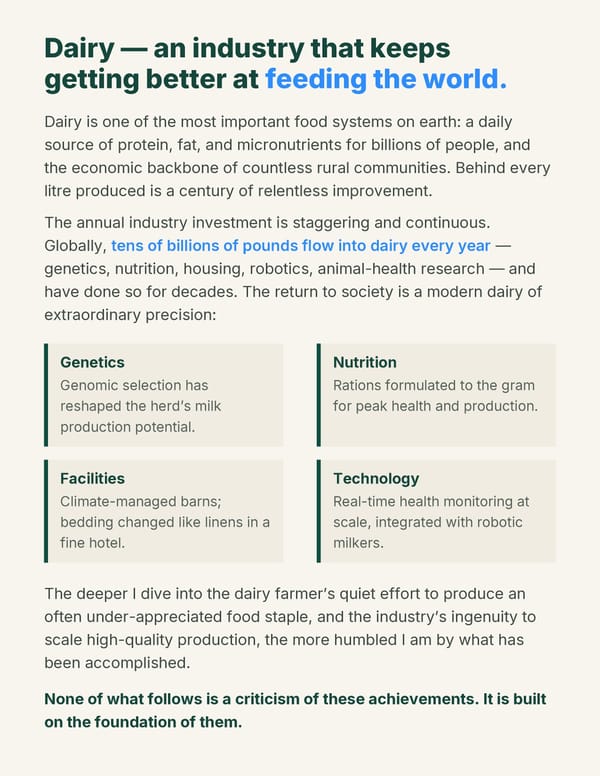
Dairy — an industry that keeps getting better at feeding the world. Dairy is one of the most important food systems on earth: a daily source of protein, fat, and micronutrients for billions of people, and the economic backbone of countless rural communities. Behind every litre produced is a century of relentless improvement. The annual industry investment is staggering and continuous. Globally, tens of billions of pounds flow into dairy every year — genetics, nutrition, housing, robotics, animal-health research — and have done so for decades. The return to society is a modern dairy of extraordinary precision: Genetics Genomic selection has reshaped the herd’s milk production potential. Nutrition Rations formulated to the gram for peak health and production. Facilities Climate-managed barns; bedding changed like linens in a fine hotel. Technology Real-time health monitoring at scale, integrated with robotic milkers. The deeper I dive into the dairy farmer’s quiet effort to produce an often under-appreciated food staple, and the industry’s ingenuity to scale high-quality production, the more humbled I am by what has been accomplished. None of what follows is a criticism of these achievements. It is built on the foundation of them.
Decades and billions spent measuring a known problem we’ve yet to fix. The highest-leverage variable remaining in dairy is a sneaky one because we’ve known about it for generations — these data are visible through milk yield and quality metrics, short-term health measures like blood metabolites, conversion metrics like rumen-pH, long-term measures like body condition — all captured by advanced wearables that add their cow-diagnostic data to the decades of global herd data we now constantly analyse with artificial intelligence. An entire modern toolset exists to describe the problem beautifully, and each year billions more are spent managing its symptoms —ration adjustments, pharmaceutical and surgical interventions, early culls, breeding positive heritable traits into replacements — yet almost none of it addresses the cause at its source. For all our progress to optimise our cows and everything around them, the one variable left almost untouched is what she does herself — in the 20+ hours no one is watching. This was not left alone through neglect, but because it seemed impossible to reach. More importantly, what matters most is what cows do in a specific, short, predictable, weeks-long window that repeats every year, for every productive cow, on every farm in the world.
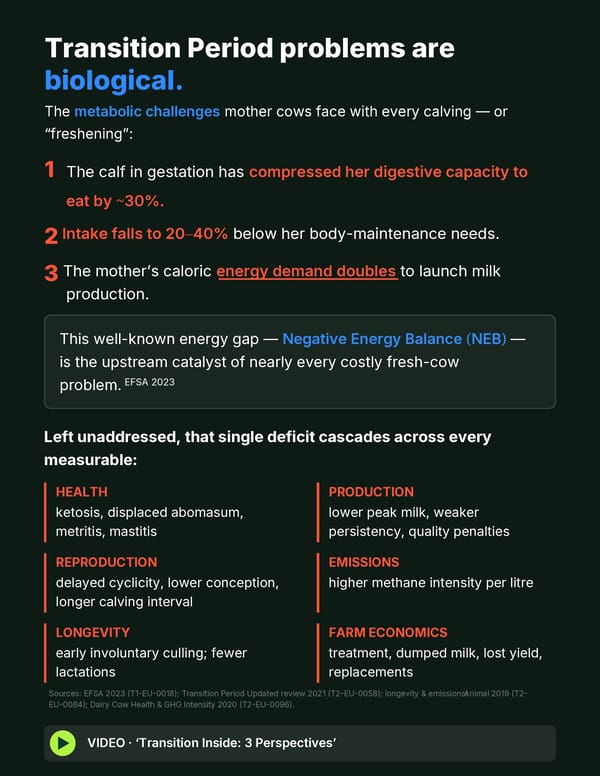
2 Intake falls to 20 – 40% below her body-maintenance needs. 3 The mother’s caloric energy demand doubles to launch milk production. This well-known energy gap — Negative Energy Balance ( NEB ) — is the upstream catalyst of nearly every costly fresh-cow problem. EFSA 2023 Left unaddressed, that single deficit cascades across every measurable: HEALTH ketosis, displaced abomasum, metritis, mastitis PRODUCTION lower peak milk, weaker persistency, quality penalties REPRODUCTION delayed cyclicity, lower conception, longer calving interval EMISSIONS higher methane intensity per litre LONGEVITY early involuntary culling; fewer lactations FARM ECONOMICS treatment, dumped milk, lost yield, replacements Transition Period problems are biological. The metabolic challenges mother cows face with every calving — or “freshening”: 1 The calf in gestation has compressed her digestive capacity to eat by ~ 30%. VIDEO · ‘Transition Inside: 3 Perspectives’ Sources: EFSA 2023 (T1-EU-0018); Transition Period Updated review 2021 (T2-EU-0058); longevity & emissions: Animal 2019 (T2- EU-0084); Dairy Cow Health & GHG Intensity 2020 (T2-EU-0096). biological.
The solution has been hidden in the fine print for decades. Across a large and growing body of primarily EU-based research —welfare science, transition-cow physiology, fertility, metabolic health, emissions — one background variable , when used as the primary filter, changes the perspective on nearly every study it appears within. When cows are grouped by Dry Matter Intake ( DMI ) , the pattern in study results is hard to unsee: transition cows with ‘High DMI’ are healthier, produce more, breed back sooner, last longer, and carry a lower emissions intensity per litre of milk produced. We have assembled a library of 100+ sources behind this single idea. Details to follow in future materials — but the clear conclusion is: intake, in transition, is the lever. Coming soon — tailored materials Which raises the obvious question. If intake is the lever, and every existing tool only measures it — what would it take to actually move it? Dairy Farmers Vets Nutritionists Investors EU Programmes Partners Research reviews Trial results ✓ ✓ ✓ ✓ ✓ ✓ ✓ ✓ ✓ ✓
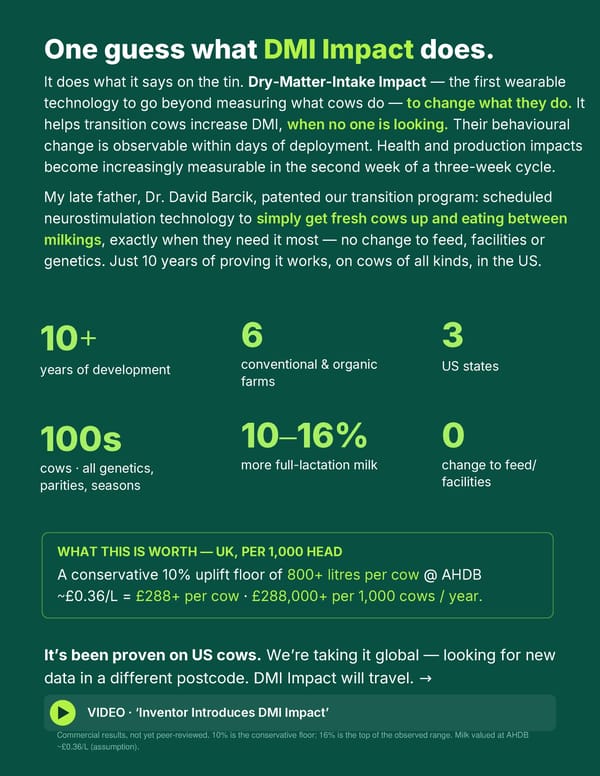
One guess what DMI Impact does. It does what it says on the tin. Dry-Matter-Intake Impact — the first wearable technology to go beyond measuring what cows do — to change what they do. It helps transition cows increase DMI, when no one is looking. Their behavioural change is observable within days of deployment. Health and production impacts become increasingly measurable in the second week of a three-week cycle. My late father, Dr. David Barcik, patented our transition program: scheduled neurostimulation technology to simply get fresh cows up and eating between milkings , exactly when they need it most — no change to feed, facilities or genetics. Just 10 years of proving it works, on cows of all kinds, in the US. 3 10 + years of development 100s cows · all genetics, parities, seasons 6 conventional & organic farms 10 – 16% more full-lactation milk US states 0 change to feed/ facilities WHAT THIS IS WORTH — UK, PER 1,000 HEAD A conservative 10% uplift floor of 800+ litres per cow @ AHDB ~ £0.36/L = £288+ per cow · £288,000+ per 1,000 cows / year. It’s been proven on US cows. We’re taking it global — looking for new data in a different postcode. DMI Impact will travel. → VIDEO · ‘Inventor Introduces DMI Impact’ Commercial results, not yet peer-reviewed. 10% is the conservative floor; 16% is the top of the observed range. Milk valued at AHDB ~£0.36/L (assumption).
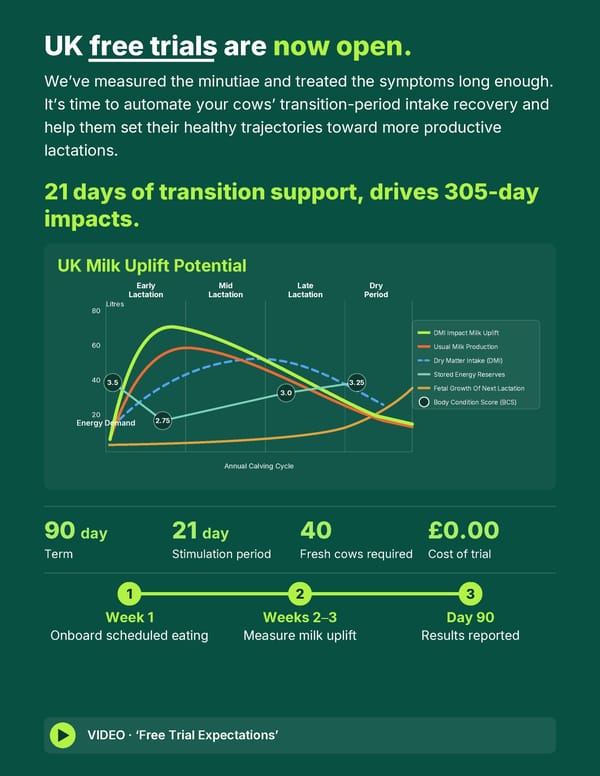
UK free trials are now open. We’ve measured the minutiae and treated the symptoms long enough. It’s time to automate your cows’ transition-period intake recovery and help them set their healthy trajectories toward more productive lactations. 21 days of transition support, drives 305-day impacts. UK Milk Uplift Potential 90 day Term 21 day Stimulation period 40 Fresh cows required £0.00 Cost of trial Early Lactation Mid Lactation Late Lactation Dry Period 80 60 40 20 Litres Energy Demand Annual Calving Cycle 3.5 2.75 3.0 3.25 DMI Impact Milk Uplift Usual Milk Production Dry Matter Intake (DMI) Stored Energy Reserves Fetal Growth Of Next Lactation Body Condition Score (BCS) 1 2 3 Week 1 Weeks 2 – 3 Day 90 Onboard scheduled eating Measure milk uplift Results reported VIDEO · ‘Free Trial Expectations’
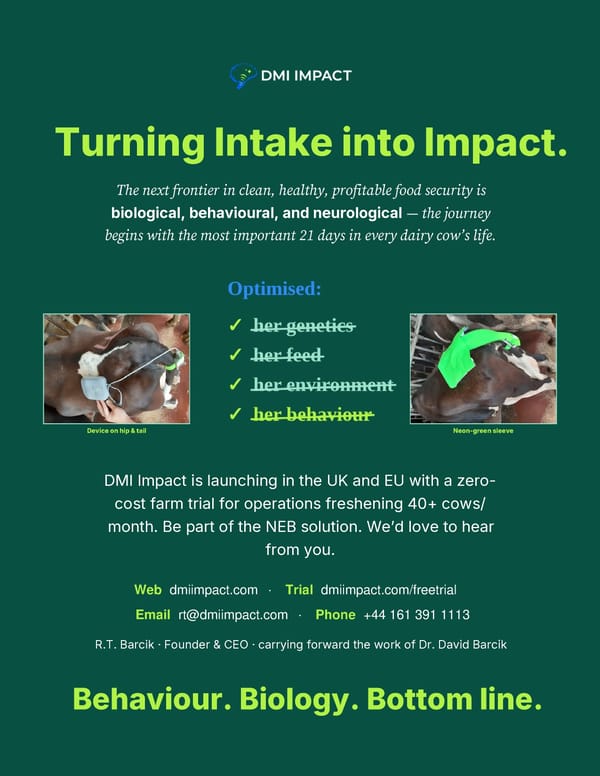
Turning Intake into Impact. The next frontier in clean, healthy, profitable food security is biological, behavioural, and neurological — the journey begins with the most important 21 days in every dairy cow’s life. DMI Impact is launching in the UK and EU with a zero- cost farm trial for operations freshening 40+ cows/ month. Be part of the NEB solution. We’d love to hear from you. R.T. Barcik · Founder & CEO · carrying forward the work of Dr. David Barcik Behaviour. Biology. Bottom line. Device on hip & tail Neon-green sleeve Web dmiimpact.com · Trial dmiimpact.com/freetrial Email rt@dmiimpact.com · Phone +44 161 391 1113